|

|

|

|

|

|

|

|
 |

|

|

|

|
 |
 |
 |
|
 |
|
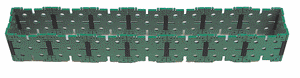
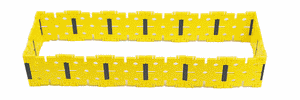
STUDYING THE RELATIONSHIPS BETWEEN AREA AND PERIMETER CONSTRUCTION TRANSFORMATIONS 3. Create a table to record area as shape changes. 4. Now change the shape of the rectangle, increasing the width by 1 unit - Fig 2. Write down the area in your Table.
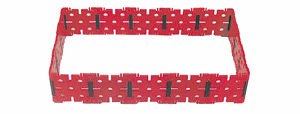
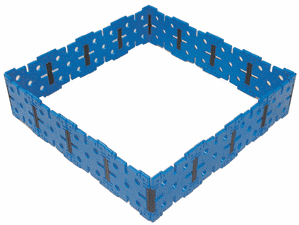
5. Change the shape of the rectangle again, increasing the width by 1 unit - Fig 3. Write down the area in your Table. 6. Change the shape of the rectangle one last time, increasing the width by 1 unit This time you will have a square - Fig 4. Write down the area in your Table. 7. Which shape gives the biggest area for a defined fixed perimeter? 8. Which shape gives the smallest area for a defined fixed perimeter? Summarizing for Parts One & Two - 9. If you want the smallest parimeter for a fixed area, what shape will you choose? 10. If you want the biggest area from a fixed perimeter, what shape will you choose? 11. Transform your model into a parallelogram, 5 units by 3 units. Will this give you an area smaller or larger than the rectangle 5 units by 3 units? If unsure, create a rectangular mat (5 x 3) and place it under your parallelogram. 12. Taking another 16 squares, create a 4 x 4 square laid flat on the table. Transform your model into an octagon (2 units to each side), and sit it over the square that you have just made. From looking at the gaps and the overlaps, do you think the area inside the octagon is larger than the square, smaller than the square, or equal to the square? 13. Would you say a circle with the same perimeter would have a bigger area again?
[Klikko Math] [Klikko Science] |
|||||||||