|

|

|

|

|

|

|

|
 |

|
 |

|

|

|
 |
 |
|
 |
|
STUDY AND DEFINITION OF 3 DIMENSIONAL SHAPES PART TWO - Pyramids DEFINITIONS
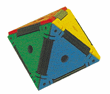
2. Build a square based pyramid using 4 triangles and 1 square frame. 3. Build a pentagon based pyramid using 5 triangles and 1 pentagon.
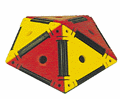
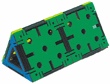
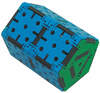
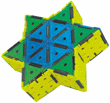
4. Identify which of the above is a tetrahedron*, and which is hexahedron, and explain why. *Tetrahedron - a polyhedron with 4 faces 5. Calculate how many faces, edges and vertices each one has 6. What are the patterns between the number of faces, edges and vertices ? When you increase the number of faces, what happens to the number of vertices ? And what happens to the number of edges ? 7. Test the formula for pyramids that E = (F x 2) - 2. And V = F PART THREE - Prisms 9. Build a quadrangular prism using 4 squares & a square frame at each end. 10. Build a pentagonal prism using 6 squares, with a pentagon at each end. 11. Build a hexagonal prism using 6 squares, with a hexagon at each end. 12. Build a star shape prism using the hexagonal prism as a base to build on.
Test your knowledge of the attributes of prisms - 13. Calculate how many faces, edges and vertices each one has 14. What are the patterns between the number of faces, edges and vertices ? 15. Test the formula for prisms that E = (F + V) - 2. And V = 2F - 4. 16. Solve these two formula to find the value of E as an expression of F.
[Klikko Math] [Klikko Science] |
|
|||||||||||||||||||||